
Week 1—September 26th
Below are the reading schedule for the first five weeks of term and the slideshow from our first class.
Download the syllabus/reading schedule for the first five weeks.
Download the first week’s slides as a PDF.
Anglo-Saxons and Public Memory: Podcast interview with archaeologist Howard Williams on the terms “Anglo-Saxon,” “English,” public history in the UK, and related issues.
Week 2—October 3rd
Handout for week 2 with Old English pronunciation and the text of Cædmon’s Hymn
NEW☞ The story of Cædmon in Bede’s Latin
At the start of our second meeting, we’ll cover the last few slides we didn’t get to last time, about what texts and manuscripts survive. Then we’ll discuss Bede’s stories of the conversion of Edwin and the poet Cædmon from Book 4 of his History, and have a closer look at Cædmon’s Hymn, our first surviving Old English poem.
Below is material on Northumbria in Bede’s time (late 7th-early 8th centuries), to which we will refer in weeks 2 and 3.
Weeks 2-3—October 3rd-10th
Bede and the golden age of Northumbria
Sites of early Northumbria on a modern Google map:
Michelle Brown’s new book on Bede:
Kindle edition and UK hardback edition.
Handouts on Insular scripts:
Slide show overview and handout on details of Insular scripts from the Manuscripts course.
Early Northumbrian manuscripts:
The Gospels of St. Augustine, Cambridge, Corpus Christi College, MS 286. 6th-century Italian Gospel book traditionally thought to have been brought with the missionaries sent by Pope Gregory.
The Codex Amiatinus, Florence, Biblioteca Medicea Laurenziana, MS Amiatino 1. A pandect—the whole Bible in one volume—completed by 716 at Wearmouth-Jarrow.
The Lindisfarne Gospels, London, British Library, MS Cotton MS Nero D IV. Lindisfarne (Northumbria, England), ca. 700. Insular Majuscule = Insular Half-Uncial.
The St. Cuthbert Gospel, London, British Library, MS Additional 89000. Wearmouth-Jarrow, early 8th century. Preserved in Cuthbert’s coffin. Still in its original binding, the oldest original binding on a European manuscript.
The Moore Bede, Cambridge, Cambridge University Library, MS Kk.5.16. Copied probably ca. 737 at Wearmouth-Jarrow. Read the “about” tab at that link for details.
Weeks 4-5—October 17th-24th
Alfred the great
“King Alfred: Was he really all that great?” A podcast with Richard Abels, biographer of Alfred. (Check back for followup episodes in which he will interview two other historians.)
My favorite podcast app: Pocket Casts. You can use any podcast app to listen to pretty much any podcast published, but I find this one has an easy interface and doesn’t fill your phone with downloaded episodes.
Slides from week 4 (history between Bede and Alfred; the authenticity of Asser and the Cotton Fire)
A characteristically entertaining review of one of Alfred Smyth’s sorties against Asser
Transcripts and editions of Asser’s text made before the Cotton fire:
- 16th-century transcript of Asser’s Life of Alfred at the British Library
- Another of the same era at Corpus Christi College, Cambridge
- 1722 printed edition including a facsimile page of the manuscript.
More on the Cotton Fire:
British Library blog post on Cotton fragments
the anglo-saxon chronicle
Overview of the Anglo-Saxon Chronicle manuscripts with links to digitized copies, from the British Library’s Medieval Manuscripts blog
alfred’s translations in manuscript
Oxford, Bodleian Library, MS Hatton 20. A manuscript of Alfred’s translation of Gregory the Great’s Pastoral Care dating from the 890s, during Alfred’s lifetime. Glosses by the Tremulous Hand of Worcester. Complete catalogue description is here.
The Paris Psalter, Paris, Bibliothèque nationale de France, MS lat. 8824. The prose translation of the first fifty psalms is by Alfred. Here is a fascinating blog post about the manuscript and its scribe.
explore alfred’s old english prose
King Alfred’s Preface to the Pastoral Care at “Old English Aerobics.” Click on any word (not just the blue ones) to get a definition and grammatical information.
The Danelaw
Wikipedia articles on the Danelaw and place name elements in Britain
More about the vikings
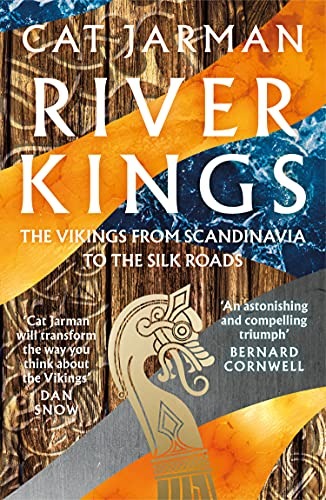
The River Kings by Cat Jarman is fantastic. It starts with artifacts from a Viking site at Mercia (Repton in Derbyshire, where I dug in the ’80s) and follows stories and up-to-the-minute archaeological discoveries to trace the Viking world in all directions. Here is a link to many copies for sale on AbeBooks. It’s also available as an audiobook.
Weeks 6-8—October 31st-November 14th
For these three weeks, we will be reading Old English poetry from The Word Exchange: Anglo-Saxon Poems in Translation. Ed. Greg Delanty and Michael Matto.
Anglo-saxon aloud
Here is Michael Drout’s site with readings of almost all extant Old English texts, most complete and some in excerpts. Not musical, but accurate and impassioned, by an expert in the field. (I have a quibble about a diphthong, which I will explain in class.)
week 6, october 31: elegies
Read all of “Poems of Exile and Longing,” the first section of the anthology, plus “The Ruin,” pp. 298-301.
week 7, november 7: biblical verse and riddles
Read in the section “Biblical Stories and Lives of Saints” the selections “Genesis A: the Fall of the Rebel Angels, “Exodus: The Israelites Cross the Red Sea,” “Judith: Beheading Holofernes,” and “The Vision of the Cross.” Browse the riddles in the anthology ad lib. and see what catches your fancy.
Here are the slides from this week’s class.
week 8, november 14: heroic verse
Read from the section “Poems about Historical Battles…”: “The Battle of Maldon,” The Battle of Brunanburh,” and “Widsith.”
If you have not recently read Beowulf, here is a PDF of Heaney’s translation with facing Old English. No need to read it for this class meeting, though you are welcome to start it or revisit it. I will talk about aspects of Beowulf as they relate to themes in everything else we’ve read this term, which I hope will illuminate your past and/or future readings of the poem.
Week 9, November 28: The End of Anglo-Saxon England
More on Domesday Book from the UK National Archives
Richard Abels’ podcast on feudalism
Week 10, December 5: The Loss and Recovery of Old English
Slides from this week’s class: the post-Conquest development of English and the scholarly recovery of Old English
Recommended for more reading on the history of the English language: The Oxford History of English
The Tremulous Hand of Worcester: Here is the video I mentioned about the collaboration among a paleographer, a neurologist, a calligrapher, and patients to understand the tremor of the scribe known as the Tremulous Hand of Worcester.
 Ruff Notes